Stock Car Racing
- 4.6
- Rating
- 50.00M
- Installs
- Free
- Price

 Analysis by App-foxy
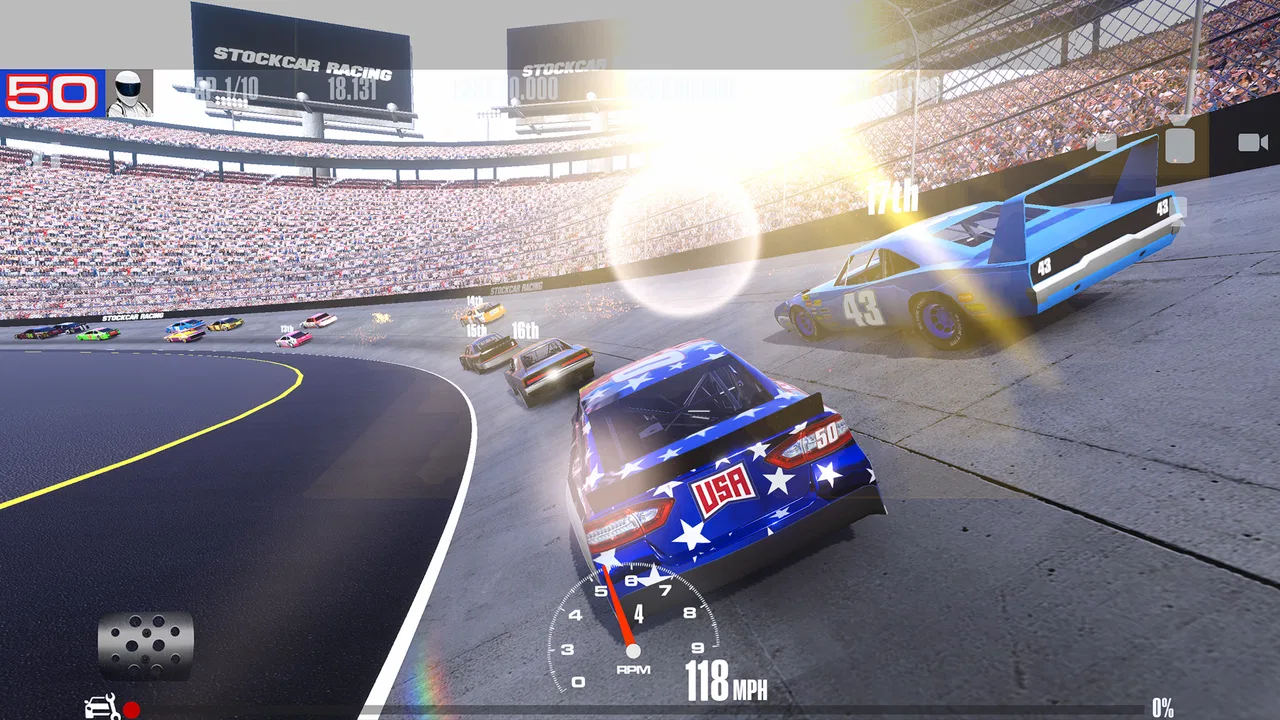
I picked up Stock Car Racing expecting a straightforward oval-track game, and that is exactly where it feels most comfortable. It is a racing game from Minicades Mobile that focuses on stock cars, dirt cars, stunt trucks, and multiplayer rather than trying to imitate every kind of motorsport at once. After spending time with it, I found the appeal is less about cinematic presentation and more about getting into a race quickly, learning how the car behaves, and deciding how aggressively to handle each lap.
The game is free to download, carries an Everyone age rating, and has grown into a very familiar choice in mobile racing, with more than 50 million installs and an average score of 4.6 from roughly 347 thousand ratings. Those figures tell me that it has reached a broad audience, but they do not remove the need to look at how it actually feels to play. For me, its strongest quality is its focused oval racing. Its biggest weakness is that the same focus can feel repetitive if I want a large open world, licensed cars, or a deep simulation.
How the game reads and navigates during a race
The basic idea is easy to understand. I choose a racing style, get onto an oval or dirt circuit, and concentrate on positioning, speed, and avoiding mistakes. That simplicity helps the game support short sessions. I do not need to remember a complicated map or learn a large collection of menus before I can drive. The racing itself gives me the clearest feedback: the track, nearby cars, corners, and the consequences of taking a poor line.
You May Also Like

 Blood Strike: 2.5 Anniversary
Blood Strike’s Loadouts Turn Every Drop Into a Tactical Gamble
A close look at Blood Strike’s custom loadouts: how fast access to signature weapons reshapes its battle royale rhythm, rewards preparation, and narrows the gap between fights.

 Pandora - Music & Podcasts
Pandora’s Music Is Easy to Start, but Harder to Recover
Pandora’s strength is its low-effort path from a seed to a station. Its weak spot is how much confidence it asks you to place in connection, setup, and quiet recovery.

 8 Ball Pool
 Is Built on Rivalries, Rematches, and Routine
A close look at the rivalries, rematches, shared routines, and unanswered safety questions that turn a quick pool match into a persistent mobile community.

 Samsung Music
’s Quiet Strength Is Playing What You Already Own
Its reach comes less from spectacle than from dependable access to a personal library. That simplicity is both the app’s strongest retention engine and its ceiling.

 AccuWeather: Weather Radar
AccuWeather Review: A Quick, Clear Forecast for Everyday Decisions
For everyday plans, the best forecast is the one you can understand quickly. AccuWeather makes rain timing, radar, and local conditions easy to act on, with a few trade-offs.

 Hill Climb Racing
Why Hill Climb Racing Still Turns Crashes Into One More Run
A tiny car, a bumpy hill and one more upgrade: Hill Climb Racing keeps resurfacing because its simple chaos makes every near-miss feel personal.
More From Our News Desk



That makes it a reasonable option for someone who finds open-world racing games visually busy. An oval track has a predictable shape, so I can focus on what is happening immediately around the car. I also appreciate that the game’s identity is clear. Stock-car racing is not presented as a minor mode inside a much larger package; it is the center of the experience. Dirt cars and stunt trucks add variety without completely changing the game’s character.
Navigation is most comfortable when I approach it as a quick-play game rather than a long-term management project. I can play a few races while waiting for a train or during a short break, then stop without feeling that I have abandoned a huge story. That is a useful difference from racing games built around long campaigns, extensive garages, or constant exploration.
At the same time, the compact structure means I need to accept some repetition. Oval racing naturally asks me to revisit similar curves many times, and the excitement comes from traffic, timing, and control rather than from discovering a new landscape around every corner. If I enjoy improving a racing line by small amounts, that repetition becomes satisfying. If I need constant visual novelty, it may become tiring sooner.
Why the straightforward layout helps some players
I found that the game’s clearest advantage for readability is its limited visual task. I am usually watching the track ahead, the cars nearby, and my position through the turn. There is less environmental clutter than in a city racer packed with buildings, pedestrians, shortcuts, and traffic. That can make the action easier to follow on a smaller phone, especially when I keep the display clean and avoid playing with distracting notifications around me.
There is also a practical learning benefit. Because the circuits are based around oval racing, I can build a mental picture of where the important moments occur. I learn when to hold a line, when to leave room, and when a pass is likely to become a collision. This is more approachable than a game that changes direction constantly and expects me to memorize many unrelated roads.
Still, readability is not the same as effortless visibility. Racing games place several moving objects close together, and a crowded pack can become difficult to interpret. A car that moves across my line may be more important than a decorative detail, but both compete for attention. I get better results when I reduce distractions in my surroundings, hold the phone steadily, and avoid trying to play while walking or doing another task.
Controls, pace, and different motor needs
For motor control, the important question is not whether the game is simple, but whether I can make small corrections without losing the car. Oval racing gives me repeated opportunities to practice those corrections. I can concentrate on steering through a turn, notice how much input is too much, and gradually become more consistent. That is friendlier than a game where a single missed corner ends a long route through a complicated map.
However, racing still demands timing. I need to react when another car closes a gap, adjust my line, and avoid overcorrecting. Anyone who has difficulty with rapid repeated touch gestures may find busy races demanding, particularly when several cars are fighting for the same space. The game’s accessible idea is its focused track layout, not a promise that every control situation will suit every player.
I would recommend starting with calmer races and treating the first sessions as control practice. Instead of chasing a perfect result immediately, I focus on making clean laps. That approach reduces the pressure to make sudden movements and helps reveal whether the control style feels comfortable on a particular device. A larger phone can offer more room for touch interaction, while a smaller screen may make close racing feel cramped.
There is a useful trade-off here. The game is more approachable than a full simulation because I can understand the racing goal quickly, but it still rewards precision. Players who want a relaxed game with almost no reaction requirement should look elsewhere. Players who enjoy a simple structure with room to improve their hand-eye timing are more likely to appreciate it.
Sound, visual attention, and sensory context
Racing is an inherently sensory experience, but I do not think I need to treat sound as the only way to understand what is happening. The most important information is visible in the track and the movement of the cars. That gives me a practical way to play in a quiet setting, on public transport, or when I do not want loud game audio around other people. I usually keep the volume low when I am playing in shared spaces.
That said, a busy race can still create sensory pressure through motion and close traffic. Repeated laps, quick changes in position, and collisions may be uncomfortable for players who are sensitive to visual movement. I find it easier to manage when I take short sessions and pause between races instead of continuing after I become tired. The game is better suited to controlled bursts than to forcing a long play period.
For players who rely on stronger visual separation, the practical solution is to play in good lighting and keep the screen free from glare. I would also avoid judging the game on a dim, cracked, or poorly positioned display, because those conditions make every mobile racer harder to read. These are not special settings inside the game; they are everyday choices that can make the track easier to follow.
The age rating of Everyone makes the game suitable for a broad family audience in terms of its listed content. That does not mean every child will find the controls easy, or that every adult will enjoy the competitive pressure. I would let a younger player try a short race first, then see whether the visual pace and touch control feel manageable before expecting longer sessions.
Playing in real-life situations
One of my favorite use cases is a short waiting period. If I have ten minutes before an appointment, I can run a few races without committing to a long narrative or a large map. The oval format works well here because I can get into the rhythm quickly. It is also a good choice for someone who wants a racing game that can be understood by watching another person play for a minute.
Multiplayer gives the experience a different social use. A race against other people can make familiar tracks feel less predictable, because human opponents do not always follow the safest line. I enjoy that when I want competition, but it also increases the need for concentration and a stable connection. For a quiet solo session, I prefer the more controlled pace of racing against the game.
Stunt trucks provide a useful change when ordinary oval racing begins to feel too disciplined. They shift the mood toward spectacle and experimentation, while dirt cars offer another variation on the handling and track surface. I would not call these additions a replacement for a completely different racing genre, but they help prevent the main stock-car format from feeling identical every time I open the app.
The game is also a sensible choice for a shared device in a family setting because the premise is easy to explain. A parent, sibling, or friend can understand the goal without reading a long tutorial. The Everyone rating supports that broad context, although I would still keep an eye on in-app purchasing if children use the device.
Where the experience still creates barriers
The free entry point is helpful, but in-app purchases range from $0.99 to $99.99 per item. That is the main financial point I would discuss before recommending it to a child or to anyone who wants a completely pressure-free experience. I would use the device’s purchase controls and agree on boundaries in advance. A free download is not the same as a cost-free progression path.
Another barrier is the gap between arcade convenience and simulation depth. I enjoy learning the feel of the cars, but someone looking for detailed real-world vehicle tuning, a broad licensed roster, or a highly technical motorsport model may find the game too focused. The usual alternative in that case is a more serious racing simulator. That may offer greater mechanical detail, but it often demands more time, more complicated controls, and a stronger device.
On the other side, an open-world racer is a better fit for players who want to explore streets, discover routes, and treat driving as a visual tour. Stock Car Racing does not provide that same sense of place. Its world is the circuit, and its satisfaction comes from racing decisions rather than sightseeing.
The game can also be a poor match for someone who dislikes repeated laps. Even with different vehicle types and multiplayer, the central rhythm remains track-based competition. I would skip it if my ideal mobile racer is mainly about collecting scenery, completing varied road trips, or driving casually without defending a racing line.
Version 3.21 shows that the game remains an actively recognizable product in its current form, while the original release dates back to February 7, 2015. That long life is reassuring for people who like an established mobile game, but it also means I approach it as a mature, focused title rather than a brand-new technical showcase. Its appeal is in the core loop, not in expecting a completely different experience every time it is updated.
Small strategies that make it easier to enjoy
My first practical tip is to stop treating every race as a passing contest. On an oval, staying predictable and leaving room can be more valuable than forcing a move immediately. I get cleaner results when I plan a pass over several corners instead of diving into the first available gap. This is especially useful in multiplayer, where an impatient move can ruin both cars’ race.
My second tip is to use the different vehicle types as a way to diagnose what I actually enjoy. If stock cars feel rewarding because of line control, I spend more time refining that skill. If dirt cars are more comfortable, I use them when I want a looser, less formal rhythm. If stunt trucks are the reason I return, then I treat the game as an arcade collection rather than expecting it to behave like a pure stock-car simulator.
My third tip is to separate accessibility testing from performance testing. I would not decide that the game is comfortable after one perfect race in a quiet room. I would try it while seated, in brighter light, with sound low, and during a short session. That reveals whether the controls remain manageable when my attention is divided or when the screen is less than ideal.
I also recommend setting a spending boundary before exploring the progression. Because the game is free and contains optional purchases, it is easy to begin casually and only later think about costs. A clear limit keeps the decision deliberate. For families, this matters more than the game’s simple presentation might suggest.
Who should install it, and who should choose something else
I would recommend it to someone who wants quick oval-track races, enjoys improving through repetition, and likes having stock cars, dirt cars, and stunt trucks in one compact game. It is particularly suitable for short breaks, casual competition, and players who prefer a clear circuit to an open-world map. The broad audience reflected in its large install base and strong average rating makes sense to me because the premise is immediately understandable.
I would be more cautious with players who need extensive control customization, find fast visual motion uncomfortable, or have difficulty with repeated touch corrections. I would also steer serious simulation fans toward a more technical alternative, and open-world fans toward a game built around exploration. Those are not failures of this title; they are differences in purpose.
For me, the best way to approach it is as a focused mobile racing game that respects short sessions. I do not open it expecting a console-style career, a huge world, or endless variety. I open it when I want to judge a corner, protect a position, try a different vehicle, or challenge another racer. That clarity is its greatest strength.
My inclusive verdict is positive, with sensible limits. The simple oval format, broad age rating, free starting point, and range of racing styles make it approachable in many everyday contexts. Its readability benefits from predictable tracks, while its motor demands remain real because close racing still requires timing and control. Sensory comfort depends heavily on the player and the surroundings, and the purchase range deserves adult attention on shared devices.
After using it, I would recommend Stock Car Racing to a friend who wants accessible-to-understand competition rather than a fully accessible-to-everyone promise. It is at its best when I play in short, focused sessions, keep the screen and environment comfortable, and accept that repetition is part of the design. If that sounds appealing, Minicades Mobile’s game is an easy free starting point. If I wanted exploration, deep simulation, or very low-pressure driving, I would choose a different racing experience instead.
FAQs for Stock Car Racing
01What is the primary objective of Stock Car Racing?
Stock Car Racing aims to provide an authentic racing experience, allowing players to compete in high-speed races using stock cars on various tracks. Players can engage in different game modes, such as multiplayer competitions, time trials, and career mode, to enhance their skills and earn rewards.
02Does Stock Car Racing require an internet connection to play?
While Stock Car Racing offers offline modes, an internet connection is necessary for certain features. Multiplayer races and leaderboard updates require connectivity to provide real-time competition and ranking. However, single-player modes can be enjoyed without an active internet connection.
03Are there in-app purchases in Stock Car Racing?
Yes, Stock Car Racing includes in-app purchases. Players can buy premium currency to unlock new cars, upgrade vehicle parts, or access special features. While the game is free to download, these purchases can enhance the gameplay experience, though they are entirely optional.
04What devices are compatible with Stock Car Racing?
Stock Car Racing is available for both Android and iOS devices. It supports a wide range of smartphones and tablets, but it's advisable to check the specific device requirements on the app store to ensure compatibility and optimal performance on your device.
05How realistic is the driving experience in Stock Car Racing?
Stock Car Racing prides itself on delivering a realistic driving experience with detailed graphics, responsive controls, and authentic car physics. Players can feel the thrill of real racing, complete with dynamic weather conditions and a variety of track environments to test their skills.
Pros
- Realistic driving physics enhance gameplay.
- Diverse car customization options available.
- Multiple racing modes for varied experiences.
- Smooth and responsive controls improve playability.
- Detailed graphics for an immersive experience.
Cons
- In-app purchases can become costly.
- Ads can be intrusive during gameplay.
- Limited track variety may reduce interest.
- Occasional lag on older devices.
- Requires constant internet connection.

Stock Car Racing
Gallery